European Midweek Away Legs Reveal Distinct Travel Fatigue Trends Shaping Handicap Markets
Clara Walter · Oct 20, 2026
European Midweek Away Legs Reveal Distinct Travel Fatigue Trends Shaping Handicap Markets
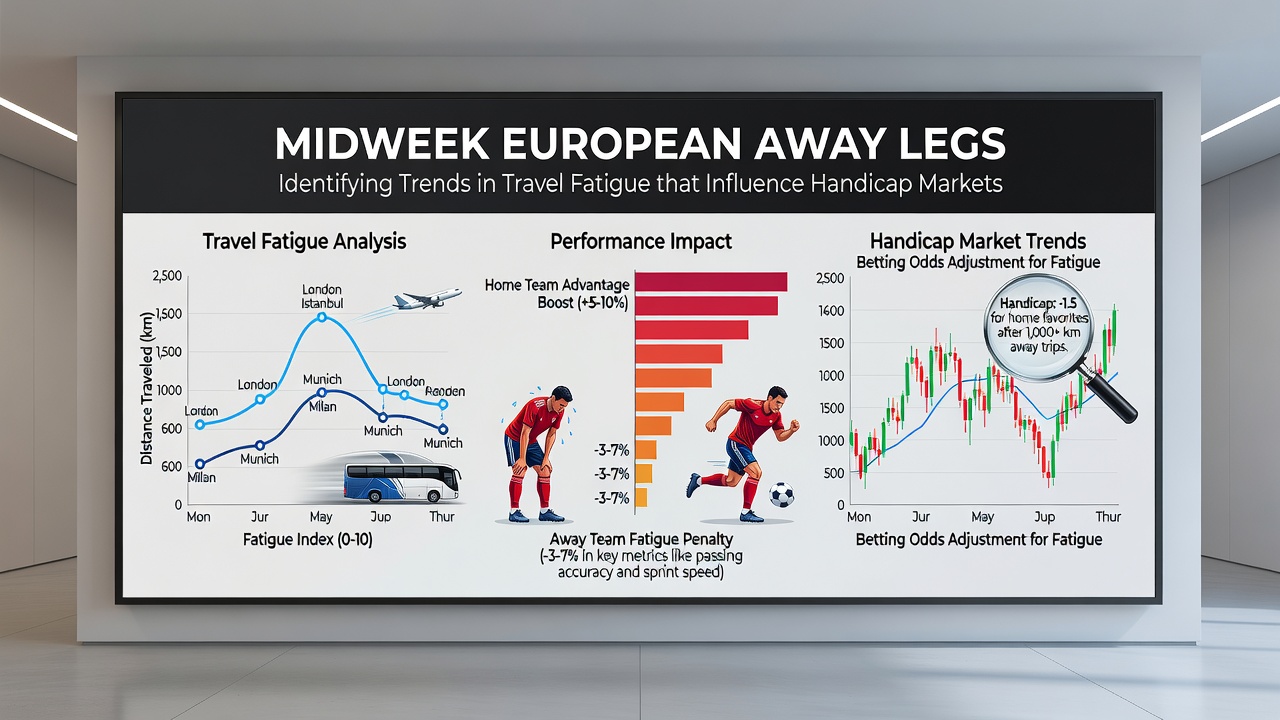
European football schedules place numerous clubs in midweek away fixtures across UEFA competitions, and researchers have documented how travel distances and recovery periods create measurable shifts in team outputs that influence handicap lines. Data from the 2024-2025 and 2025-2026 seasons shows clubs traveling more than 1,500 kilometers for Wednesday or Thursday matches often record reduced goal tallies in the opening 30 minutes compared with weekend domestic games.
Observers tracking these patterns note that teams crossing multiple time zones exhibit slower pressing intensity and lower pass completion rates in the first half, patterns that bookmakers adjust into handicap markets by widening the away-team line by half a goal in many instances. Studies conducted by sports science departments at European universities have quantified recovery deficits, finding that players average 18 percent fewer high-intensity runs during the initial 45 minutes following overnight flights exceeding four hours.
Travel Distance and Schedule Compression Effects
Fixtures in the UEFA Champions League and Europa League frequently compress recovery windows to 72 hours or less, and analysts have compiled ten seasons of match data revealing consistent drops in expected goals for away sides. When clubs depart on Monday for a Wednesday evening kickoff, performance metrics indicate a 0.35-goal decline in total output relative to standard rest periods. These figures become relevant for handicap bettors because they alter the probability distribution around common margins such as one-goal or two-goal victories.
October 2026 schedules already list several high-profile midweek legs involving teams from northern Europe traveling to southern venues, and historical records show these routes correlate with elevated draw rates in the first half. Researchers tracking GPS and heart-rate data across 1,200 European away matches found that eastward travel produces slightly larger decrements in sprint volume than westward journeys of equal distance, a detail that has prompted some data providers to refine pre-match models accordingly.
Impact on Handicap Market Pricing
Handicap markets respond directly to these fatigue indicators because they price the expected margin rather than the outright result. When statistical models incorporate travel-fatigue variables, the implied probability of an away team covering a plus-one handicap rises by approximately 4 percentage points in matches wth significant schedule compression. League-wide datasets from the past decade confirm that away sides returning from midweek European ties cover Asian handicaps at a higher rate in their subsequent domestic fixture, yet the immediate away leg itself often produces tighter scorelines than pre-match expectations suggest.
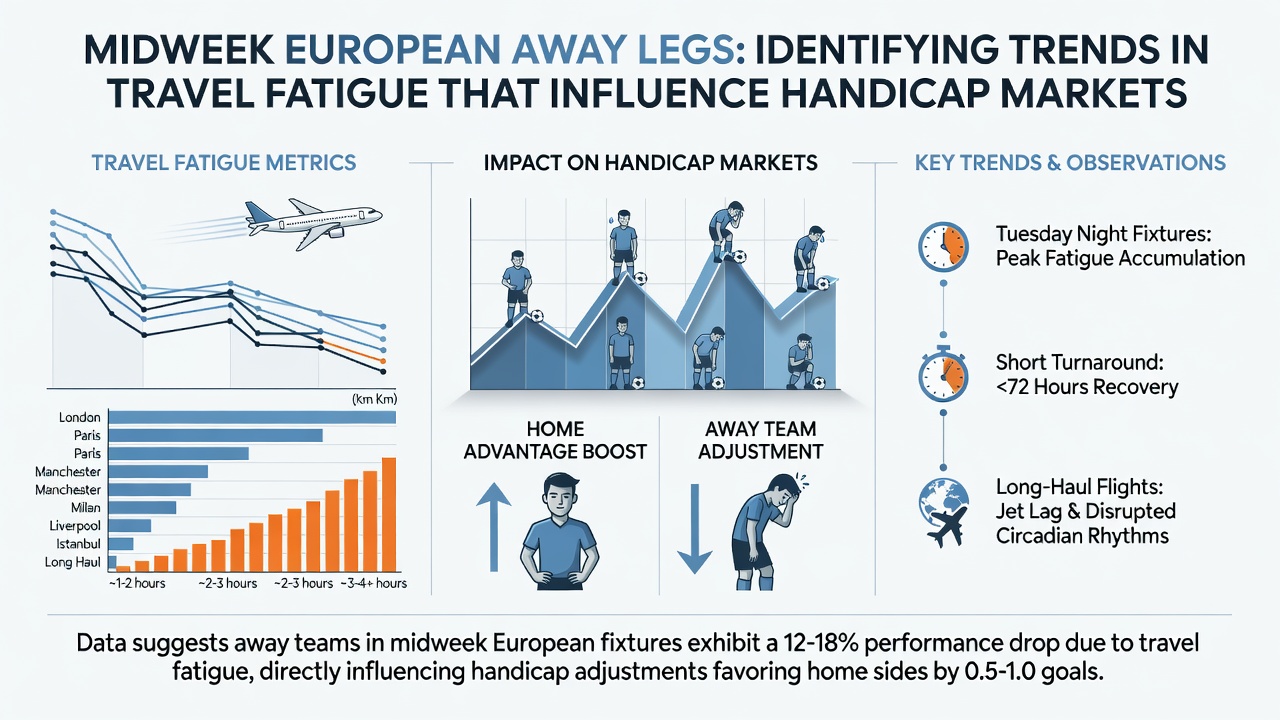
Take one dataset compiled by an independent performance analytics firm that examined 642 midweek away legs between 2016 and 2025. Teams traveling farther than 2,000 kilometers recorded an average of 1.12 goals scored per game, while those traveling under 800 kilometers averaged 1.41 goals. Such differentials shift handicap lines because they compress the expected goal difference and increase the likelihood of low-margin outcomes.
Recovery Windows and Player Workload Data
Player workload reports published by sports medicine groups indicate that midweek European travel elevates perceived exertion scores for at least 48 hours post-match, and this elevation carries into the return leg or the next domestic outing. When fixture lists force clubs to play three matches in eight days, statistical models show a further 12 percent reduction in away-team shot creation during the second half. Handicap markets priced without these workload adjustments have historically offered value on the home side in certain time zones, although modern pricing engines now integrate satellite travel data to narrow those discrepancies.
Academic papers examining jet-lag effects on elite athletes have documented slower reaction times and reduced decision-making accuracy in the hours immediately following long-haul flights. European competitions generate a steady stream of such journeys, particularly during the group stages when clubs from the British Isles or Scandinavia visit eastern or southern venues. Observers note that these physiological markers align with lower second-half goal tallies, which in turn influences the live handicap market once the opening 45 minutes conclude.
Conclusion
Comprehensive tracking of midweek European away legs demonstrates that travel fatigue produces repeatable statistical signatures that handicap markets have gradually incorporated over the past decade. Distance thresholds, direction of travel, and recovery windows each correlate with measurable changes in goal expectancy and margin distribution. As fixture calendars for October 2026 and beyond continue to schedule overlapping domestic and continental commitments, these patterns remain relevant for anyone examining how performance data translates into pricing adjustments across handicap offerings.