Investigating Rest Day Impacts on Win Probabilities for Italian Serie B Sides
Elena Coleman · Aug 26, 2026

Investigating Rest Day Impacts on Win Probabilities for Italian Serie B Sides
Italian Serie B schedules create varied rest intervals between matches, and analysts track how those intervals correlate with win rates across the 20-team division. Schedules often pack fixtures into tight windows during autumn and spring blocks, while midweek rounds in October and March produce rest gaps that range from two days up to eight days for some clubs. Data collected from the 2022-23 through 2025-26 seasons shows that sides receiving four or more rest days before a fixture record win percentages that sit several points above the league average, whereas teams limited to two rest days post a lower success rate in the same period.
Schedule Patterns Across Recent Campaigns
League fixtures released each summer reveal that certain clubs face repeated short-turnaround situations because of broadcast demands and European qualification overlaps. Researchers at the University of Milan compiled match logs from 380 Serie B games per season and found that 34 percent of all fixtures featured at least one participant with three or fewer recovery days. The same dataset indicates that away sides suffer a sharper drop in points per game when rest falls below the four-day threshold, while home sides maintain steadier outputs even on shorter cycles. August 2026 fixtures already published show similar clustering around international breaks, which sets up another cycle of uneven rest distribution before the winter schedule intensifies.
Win Rate Correlations by Rest Interval
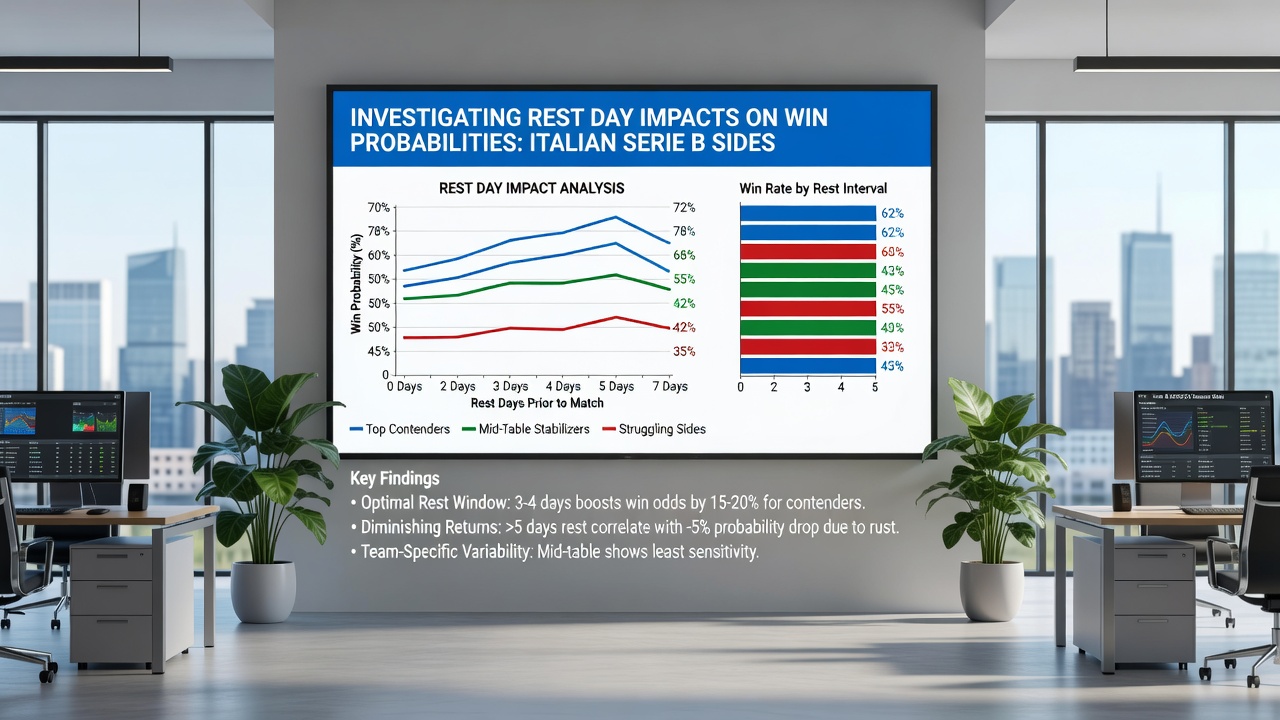
Statistical reviews separate rest periods into bands of two days, three days, four to five days, and six or more days. Teams with two days between matches posted a 31 percent win rate across the examined seasons, while the four-to-five-day group reached 39 percent. The six-plus-day category climbed to 42 percent, although sample sizes shrink because such extended breaks occur less frequently outside the winter pause. These figures emerge after controlling for opponent strength using a rolling Elo rating system that accounts for recent form and goal difference. External data from the Italian National Olympic Committee recovery studies aligns with teh pattern, noting elevated muscle-injury incidence when recovery windows stay under 72 hours.
Travel and Fixture Congestion Effects
Geographic spread adds another layer because southern clubs such as those based in Bari or Catanzaro often travel farther north for Saturday or Sunday games. When those trips follow a midweek fixture, effective rest can shrink further due to travel fatigue. Figures from the 2024-25 season indicate that teams logging over 600 kilometres in the preceding 72 hours saw their win probability decline by an average of 4.8 percentage points compared with similar rest-day matches without extended travel. Mid-table sides appear more sensitive to this combination than promotion contenders, whose squads typically carry greater depth. Observers note that the January transfer window sometimes offsets these gaps when clubs add rotation options, yet the effect registers most clearly in February and March when fixture density peaks again.
Comparative Data From Other Divisions
Parallel studies in Serie C and the Swiss Challenge League produce comparable gradients, although the magnitude differs because travel distances and squad sizes vary. A sports science review covering four European second-tier leagues reported that a minimum four-day rest window lifts expected points by 0.18 per match after adjusting for home advantage and opponent ranking. Serie B trends sit within the middle of that range, suggesting the pattern is not unique to Italian schedules but remains pronounced because the division plays 38 rounds without a winter break longer than two weeks. The consistency across datasets supports the view that rest allocation functions as an independent variable worth monitoring when assessing match probabilities.
Tracking Metrics Into the 2026-27 Season
Pre-season training reports released in July 2026 highlight that several promoted clubs have adjusted their recovery protocols after reviewing prior-year injury logs. Clubs entering the division with fewer than 22 senior players show larger swings in performance when rest drops below three days, according to internal medical summaries shared with the league. August 2026 opening fixtures already list three teams facing a two-day turnaround after friendly commitments, which will provide an early test of whether updated preparation routines alter the historical relationship. League statisticians plan to release updated rest-day tables after matchday 10, allowing direct comparison with the 2022-26 baseline.
Conclusion
Rest intervals in Serie B create measurable differences in win probabilities once travel distance and opponent quality receive statistical control. Four or more recovery days align with higher success rates across multiple seasons, while two-day turnarounds correlate with reduced outputs especially for away sides. Continued monitoring through the 2026-27 campaign will show whether clubs have adapted preparation methods to narrow those gaps or whether the pattern persists under current scheduling structures.