Rally Length Patterns Reveal Momentum Dynamics in Table Tennis Sets
Elena Coleman · Nov 17, 2026

Rally Length Patterns Reveal Momentum Dynamics in Table Tennis Sets
Table tennis sets often hinge on subtle shifts that unfold over multiple points, and rally length data provides a measurable way to track those changes in real time. Observers note that shorter rallies tend to cluster during periods of aggressive play, whereas extended exchanges signal defensive stability or tactical adjustments from one player to the other. Data from major tournaments shows these patterns repeat across elite matches, offering a framework for monitoring how control moves between competitors.
Researchers at institutions focused on sports analytics have compiled rally duration statistics from thousands of points, revealing consistent correlations with scoring runs. When average rally times drop below four seconds for several consecutive points, the player initiating shorter exchanges frequently builds an advantage that lasts through the remainder of the set. Conversely, rallies stretching beyond eight seconds often precede a reversal, as the defending athlete regains composure and forces errors.
Collecting and Interpreting Rally Metrics
Match tracking systems used by governing bodies record precise timestamps for each point, allowing analysts to calculate durations from serve to conclusion. Figures from recent international events indicate that sets featuring a momentum swing display a distinct sequence: an initial phase of balanced rally lengths gives way to a cluster of brief exchanges, followed by a return to longer rallies once the trailing player adapts. Those who've examined these sequences across multiple competitions find the transition typically occurs within a five-point window.
Coaches and performance teams apply this information during live sessions to adjust strategies, yet the same datasets serve broader applications in markets that update continuously. Studies conducted through partnerships with regional sports science centers demonstrate that incorporating rally length into predictive models improves accuracy for identifying which athlete holds the current edge, particularly in later stages of a set when fatigue influences decision-making.
Application to In-Play Market Dynamics
In-play platforms adjust offerings rapidly as points conclude, and rally length supplies an objective input for those adjustments. Data indicates that periods of shortened rallies coincide with higher volatility in point outcomes, creating windows where market movements reflect emerging dominance rather than random variance. Analysts tracking events in November 2026 noted several matches where sustained reductions in rally duration preceded extended scoring sequences by the same competitor.
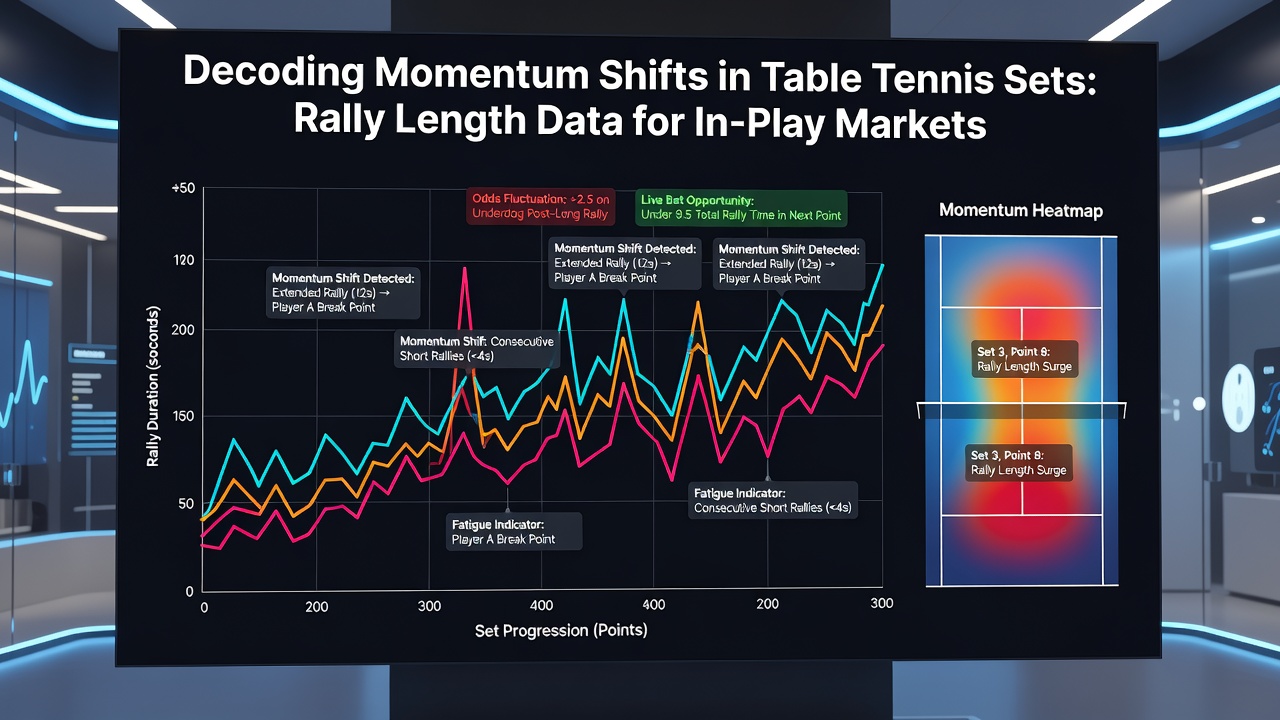
Longer rallies, meanwhile, tend to stabilize scoring rates and reduce the frequency of large leads. According to reports compiled by European sports research networks, this stabilization allows participants to reset positioning and alter spin or placement, often neutralizing an earlier advantage. Observers tracking these shifts across professional circuits report that sets rarely conclude without at least one measurable change in average rally length, underscoring the metric's reliability as an indicator.
Regional Data Comparisons and Patterns
Comparisons between Asian and European tournaments highlight slight variations in baseline rally durations, influenced by playing styles prevalent in each region. Australian Institute of Sport publications have documented how these regional differences affect the timing of momentum transitions, with certain nationalities exhibiting quicker adaptations to shortened rally phases. Such findings enable more granular analysis when matches feature players from diverse backgrounds.
Industry groups monitoring equipment standards also contribute context, noting that ball and table specifications influence rally lengths uniformly across events. When combined with historical set data, these variables refine expectations for how long a given momentum phase might persist before the next adjustment occurs.
Conclusion
Rally length data continues to supply a practical lens for understanding set progression in table tennis. Patterns identified through systematic collection and regional comparisons demonstrate repeatable sequences that align with changes in player control. As tracking technology advances, integration of these metrics into real-time environments offers expanded opportunities for precise observation of match flow without reliance on subjective interpretation.